Do Cats Love Their Humans? What Science—and Our Cats—Tell Us
The debate started innocently enough.
My husband and I were talking about cats when the subject came up: Do cats actually love their humans?
I said they absolutely do.
My husband disagreed.
“Cats don’t love people.”
Now, I could have let that statement go.
I did not.
Because if you’ve ever lived with a cat, you probably know exactly why this question isn’t quite as simple as it sounds.
Cats don’t always greet us at the door with a wagging tail. They don’t necessarily follow us around looking for approval. And they certainly aren’t known for making their feelings obvious every second of the day.
But does that mean they don’t love us?
Not necessarily.
In fact, research into cat-human relationships suggests that our feline companions may form much deeper emotional bonds with us than they’re sometimes given credit for.
What Does It Mean for a Cat to Love Someone?
Here’s where things get complicated.
We can’t ask a cat, “Do you love me?” and expect a useful answer.
Well, we can ask. We just probably shouldn’t base our scientific conclusions on the response.
Scientists instead look at observable behaviors that indicate attachment, social connection, trust, and emotional significance.
And cats have demonstrated some pretty interesting abilities in these areas.
A 2019 study published in Current Biology examined attachment between cats and their human caregivers using a test adapted from research on attachment in children and dogs. The researchers found that many cats showed patterns consistent with secure attachment to their caregivers. Both kittens and adult cats displayed behaviors associated with attachment, including seeking proximity to their caregiver, experiencing distress when separated, and responding differently when the caregiver returned.
In the study, about 65% of adult cats were classified as securely attached to their caregivers.
That’s not exactly what you would expect if cats simply viewed us as walking food dispensers.
Cats Can Form Attachments to Their People
Attachment isn’t necessarily the same thing as human romantic love, of course.
But it is meaningful.
A securely attached animal can use another individual as a source of comfort and security while also feeling confident enough to explore its surroundings.
That is important because cats are sometimes portrayed as solitary creatures that tolerate humans primarily because humans provide food and shelter.
The research paints a more complicated picture.
Cats are socially flexible animals. Some are highly social, some are more independent, and individual cats can differ enormously in how they interact with people. Researchers have found evidence that cats can develop different kinds of relationships with their owners, ranging from relatively distant relationships to much closer bonds characterized by emotional investment and a desire for proximity.
In other words, there isn’t one universal “cat personality.”
Some cats want to be involved in everything you do.
Some want to sit six feet away and supervise.
And some apparently believe personal space is a terrible human invention.
So Why Don’t Cats Show Love Like Dogs?
This may be where cats get misunderstood.
Dogs and cats aren’t the same species, and they don’t necessarily communicate affection in the same ways.
A dog may enthusiastically greet you, lean against you, follow you from room to room, and make its excitement extremely difficult to miss.
A cat might express affection by quietly choosing to sit beside you.
Or sleeping on your bed.
Or following you into the bathroom for reasons that remain classified.
Or greeting you with a little chirp.
Or slowly blinking at you from across the room.
Or climbing onto your lap when nobody else is around.
These behaviors may look subtle compared with the exuberance of some dogs, but subtle doesn’t mean meaningless.
Research on cat-human interactions has found that cats and humans develop individual patterns of communication and interaction. The relationship is influenced by both partners—the cat’s personality and socialization, the human’s behavior, and how the two respond to one another.
That last part matters.
A relationship is a two-way street.
Maybe Your Cat’s Love Doesn’t Look Like Your Idea of Love
This is where I think the argument gets really interesting.
When we say a cat “loves” us, we shouldn’t necessarily mean that a cat experiences love in exactly the same psychological way a human does.
We can’t know that.
But we can observe something very real: cats can form lasting social and emotional bonds with individual people.
They can prefer certain people.
They can seek comfort from their caregivers.
They can show distress when separated.
They can seek proximity.
They can greet their people after an absence.
And they can develop unique relationships with the humans they live with.
Maybe the better question isn’t:
“Do cats love us?”
Maybe it’s:
“What does love look like when the one doing the loving is a cat?”
And Then There’s Rebel
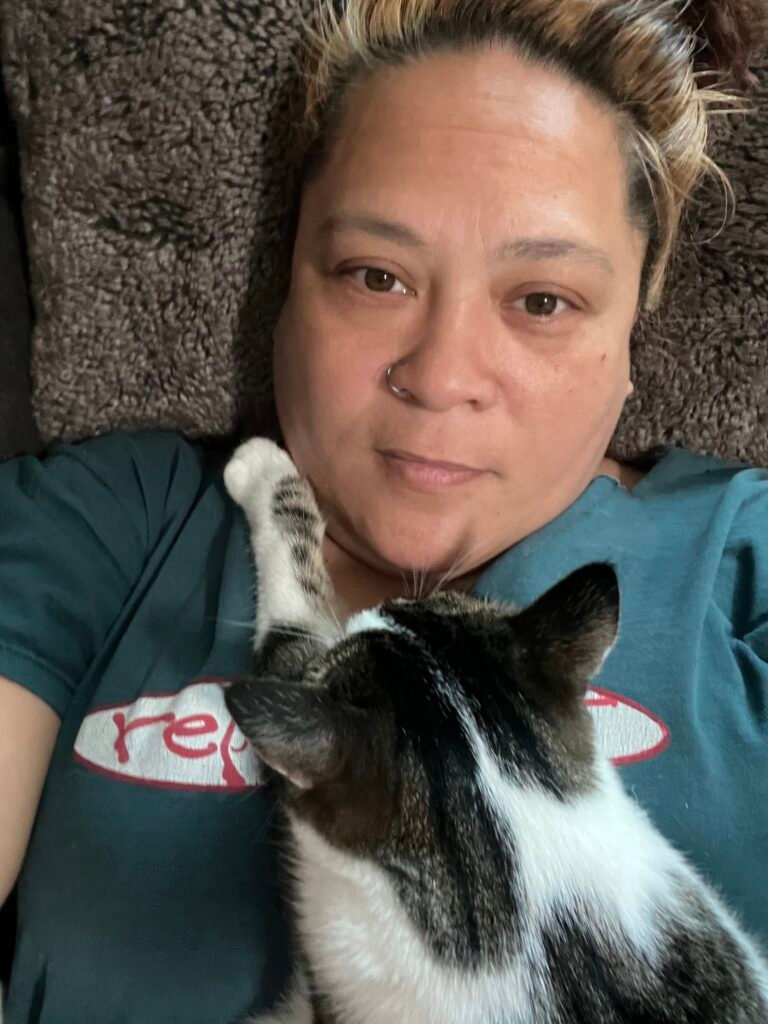
In my house, this is where my argument gets a little personal.
Rebel has her own ways of showing that she wants to be around us.
She follows me around the house.
She wants to be near us.
She sleeps in her favorite spots and occasionally decides that what she really needs is to crawl under the covers and touch me while she sleeps.
She carries her favorite toy around.
She makes biscuits.
She watches what we’re doing.
And, occasionally, she demonstrates her affection by behaving like a tiny furry criminal.
But that’s Rebel.
Her personality is part of the relationship we have with her.
And I don’t need her to behave like a dog—or a person—to believe that our relationship means something to her.
Does That Mean Cats Love Us?
Here’s the honest answer:
We can’t prove that cats experience love exactly the way humans do.
But we can say something much more interesting.
Research shows that cats are capable of forming attachment bonds with humans, including secure attachments. Studies also show that cat-human relationships can involve attachment, proximity-seeking, and individual patterns of social interaction.
So when someone says, “Cats don’t love people,” I think the evidence makes that statement a little too simplistic.
Maybe cats don’t love us in exactly the way we love them.
Maybe they don’t need to.
Maybe their version of love is quieter.
It’s choosing to sleep beside you.
It’s following you from room to room.
It’s trusting you enough to relax completely in your presence.
It’s coming to you when they’re frightened.
It’s greeting you when you return.
It’s sitting beside you simply because they want to.
And sometimes, it’s just looking at you with those mysterious eyes as if they’re trying to decide whether you’re worthy of another day in their kingdom.
So, do cats love their humans?
I can’t speak for every cat.
But as far as Rebel is concerned?
I’m pretty sure the answer is yes.
And I’m not entirely sure my husband has a case.
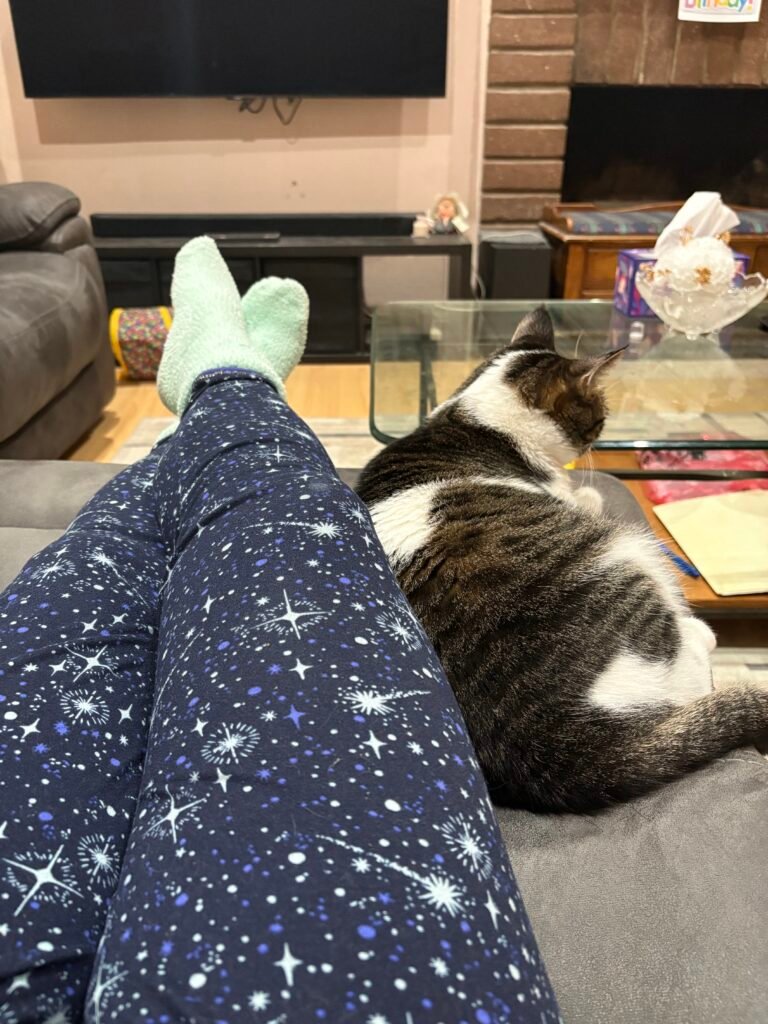
What Do You Think?
Does your cat show you affection?
Does your cat follow you around, sleep beside you, greet you when you come home, or seek you out when it wants comfort?
Or do you have one of those cats who appears to love you primarily from across the room?
Tell us about your cat—and what makes you believe your cat loves you.
🐾 Continue the Adventure
Rebel has plenty more stories to tell…
Whether she’s following me from room to room, testing gravity one object at a time, or getting into a little harmless mischief, there’s always another adventure waiting.
Where will Rebel take you next?
🐾❤️ Why Cats Make Such Good Companions
🐾 Why Does My Cat Follow Me Everywhere?
📚 Explore Cat Stories
🐱 Explore Cat Behavior
📚 Explore Cat Care
🩺 Explore Cat Health
Want to Meet Rebel?
“If you’re wondering how Rebel became my tiny shadow in the first place…”